
Peering into the abyss: Life after the disruption
Focusing on the longer term during a disruption is incredibly hard. While all strategy is an attempt to manage uncertainty, in a major disruption that uncertainty is magnified tremendously. Unfortunately, what’s easiest for beleaguered leaders is to follow the path of least resistance. Since they don’t know what will happen or when (including when and how this disruption will end), leaders often default to the only thing they know: how stuff worked before the disruption. History tells us, though, that the only certainty is that life post-disruption will not go back to life pre-disruption. There are always some lasting changes.
Faced with that uncertainty, too many leaders default to just managing the short-term. They hunker down and micro-manage day-to-day, ignoring what’s going on around them. They say they wish they could think about the longer term, but that is a luxury they can’t afford. They apologetically push off the longer-term until “the time is right.” As a result, they may manage brilliantly – but utterly fail to lead. And by ignoring the long-term, they risk taking their organizations in the wrong direction, endangering their long-term strategic and tactical options.
Effective leaders aren’t afraid to face the uncertainty. They don’t claim to know the future, but they take it into account. In the process, they show their people that they are thinking about the long term, even while leading them through the short-term.
People will put up with an unclear future if things are going well now. They will put up with a lousy situation now if they see the chance for a better future later. But if all they see is a lousy now and an unclear later, don’t expect them to stay with you if they have any alternatives, or to produce much as long as they do stay. You don’t have to make promises or predictions: just show them that you’re working on the long-term while still managing the short-term.
Unlocking the longer term: Scenarios
So how do you do strategy in the face of massive uncertainty? One trusted tool is scenarios. Start to think about hypothetical futures – not what will happen, but what might happen. Thinking about those scenarios will help you think about:
- What to prepare for;
- What to hope for;
- What to watch for; and
- Just maybe, what to work for.
We can use history as an input to those scenarios. Historical analogy is dangerous but historical ignorance is more dangerous. We thought this election would put us back in the 1980s. We quickly realized instead we were going back to the 1950s, then the 1890s and now we realize we are being asked to live in the 1850s in terms of public health, social justice, environmental care, global relationships and simply functioning democracy. The mental models from the 1850s, which took root both in early American companies and entrepreneurs and also in the myth of the Lost Cause, have some clear elements (that was the age of Manifest Destiny, after all). It is not a coincidence that climate change, DEI and social justice are all at the top of the target list. This is not just political opportunism or rewarding contributors, but reviving the “domination” and superiority model of the 1850s – which was carried out both on people and on the land (see David Silkenat's brilliant Scars on the Land).
Starter scenarios
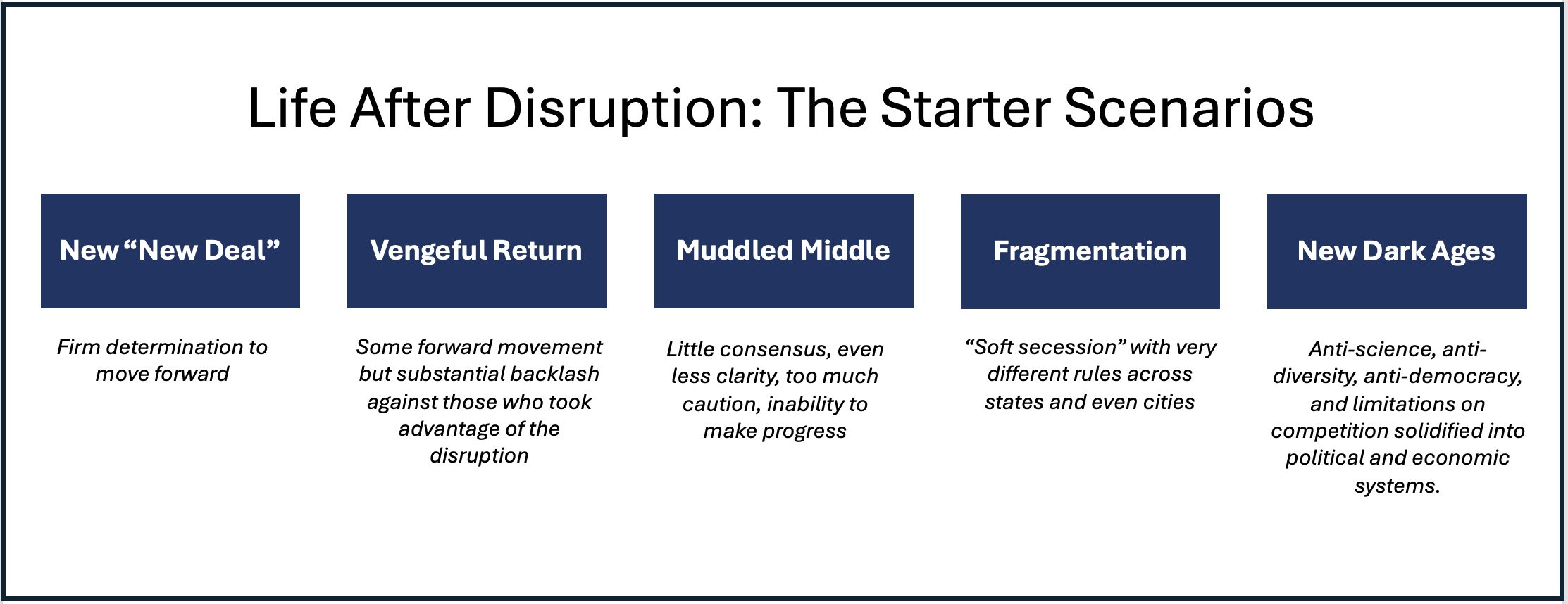
Starting from where we are now, and assuming that the current disruption will last at least another few years, we can readily identify 5 potential scenarios for the 5–15-year time range:
- New “New Deal”. There is a firm determination to move forward, not to return to the past. Like the original American Revolution, the revolution of Lincon and the Civil War, and the Roosevelt Depression response, this disruption produces new expectations and new structures to meet those expectations. Particular targets include the role of money in politics, cronyism, truth in journalism and science, and the suppression of minorities and civil liberties. There is a consensus for major investment in new social support structures, global collaborative solutions, and slowing and adapting to climate change.
- Vengeful Return (Revanchism). The political pendulum swings back toward the left. Those concerned about things like climate, environmental justice, social equity and LGBTQ+ rights come back into power. But this time, there is no “forgive and forget” or “let’s move on”. The damage is too deep, the scars are too raw, the anger – and fear – are too real. Think of stages of the French Revolution, or Oliver Cromwell’s “posthumous execution.” Companies (and projects) who took advantage of the disruption to renege on climate or DEI promises, or to do things under lax regulation that was illegal before, become the targets of regulatory, legal, investor and consumer backlash.
- Muddled Middle. Nothing is clear, leading to exhaustive ineffectual processing. The urge to curb executive overreach leads to new guardrails, protections, and regulations, which make everything slower. Nobody wants to go backward, but nobody agrees on how to move forward. In this social inertia, a lot less negative stuff will happen – but not much positive stuff can happen either.
- Fragmentation. Across the US, different states (and even cities) emerge with radically different rules, especially regarding most sustainability-related issues. The Federal government lacks the resources and credibility to resolve most issues. The cohesion (and power) of the US is demonstrably weakened. (Analysts have already referred to this as “soft secession”.)
- New Dark Ages. Anti-science, anti-diversity, anti-democracy, and limitations on competition have become solidified into political and economic systems. Lots of little Savonarolas continue to pop up, eager to crush diversity in population, thought, and culture. Resistance is not tolerated.
What to do with those scenarios
To be clear, these are not predictive. Obviously, I don’t know what will happen. I’m not a seer or oracle. I’m just an old guy who’s been through a lot of stuff.
But these scenarios can help you think about what future is more or less likely; what scenarios are missing from this early analysis; and what signals to watch for that may tell you more about relative probability (or emergence of alternative scenarios).
Mechanically, you can then think about your world:
- What are the impacts on your location, your sources and markets, your stakeholders, your competition, etc. in each scenario?
- Under each scenario, in broad scope, what about your current world would be likely to be the same as pre-disruption, and what would probably be different?
You can then think about how you (and your programs and whole organization) would be (or want to be) positioned for each of those scenarios.
- What are you considering now that would leave you particularly well-positioned for some scenarios?
- What are you considering now that would leave you at risk in some scenarios?
We certainly don’t know what will happen after this disruption. The only thing we can predict is that we won’t return to Bidenland. Sure, all the other scenarios seem scary and possibly even unlikely. Even so, going back to the status quo ante is, quite simply, the least likely scenario of all. Make sure that’s not what you’re really preparing for or depending on.
Member discussion